Pages

Showing posts with label assessment. Show all posts

Saturday, October 15, 2016

bigtime reflections

We just finished up a short week and I wanted to share and reflect on it with you!

Pineapple Chart
This has been a long time coming, but it finally launched this Wednesday!


The Pineapple Chart concept is from Mark Barnes and Jennifer Gonzalez who wrote Hacking Education. It's a way to invite teachers to your classroom in a space (our lounge) that everyone hangs out. Then, teachers can check out classes that are on the chart.

We just launched it on Wednesday, and there were four teachers to put up an invitation - to a band class (trumpets!), Math Class, to see a cool app called Class Kick, a Social Studies Class to see a learning platform called Summit, and my ELA class to see Quick Writing.

What's awesome about the Pineapple Chart is that there's no subs involved, no paperwork, no formal reflections - just teachers visiting one another's classrooms to learn and collaborate together.


I visited the math class to see Class Kick and the app was super cool, but it's also cool to just be in another teacher's room to see how the students interact, to see how they organize and structure their class, to talk to kids, and 100 more reasons!


I highly suggest this form of on-demand, personalized PD - check out Hacking Education for this great Hack, and so many others! (My next project is Teacher Quiet Zone!)


Quick Writing
I've been doing Quick Writing for about 6 weeks now and it's making such a difference in the kids stamina for writing. (Check out the details here.) We are about to launch our first writing unit, and I know the Quick Writing will lend itself to the writing they will do for me coming up! I'm just so proud to see kids really getting to business with their writing, this example was just about 7 minutes worth of writing! This strategy helps kids get out of their head, stop the writer's block, and just let thoughts flow on to paper, because we know that the real writing lies in revision.


Progress Reports
One area I've been struggling is communicating grades with parents. Like, I have grades in my book, but I am not super sure how to use our online management system and so until yesterday, I hadn't done much of that. I tell you this not so you'll be judgy, but because what I'm learning as a teacher and coach is that it's so hard to do everything. The last few years when I was just a coach, I would attend meetings, and to me, it seemed simple the plans that we would make for instruction. But then there's assemblies, and shortened schedules for PBIS kickoffs, and days off, and then there's a day or two when none of your students do their homework, so the plan that you've created, it doesn't go as you had envisioned.

But then something amazing happens anyways, and I'm so mad I didn't snap a picture of this - my kids doing self-reflection on their progress reports.

We have moved to Standards Based Grading. I like it. So I created progress reports for kids, where I had it broken down into seven categories, listing the scores I had recorded for kids. Then, I asked them to reflect on scores, share something they're doing well in each area, and also something they need to improve. And I had them spend about 20 minutes on self-reflection, using my notes and grading themselves. And it was amazing.

Kids made comments like,

  • "I need to study my vocabulary more."
  • "I need my handwriting to be neater."
  • "I should share my ideas with people I sit with more."
  • "I wasn't taking this seriously, but now I will."
  • "I need to be kinder to others in my class."
  • "I have a lot of tardies, I need to come on time." (Side note: yesterday this student *was on time!)
I have always been a reflective teacher (like, here on the blog) but I am going to make this self-reflection for students an ongoing process. Oh, and then my principal (who initiated this whole idea for me) shared how I could take it to the next level - have parents rate themselves for things at home like,
  • My child gets 8 hours of sleep a night.
  • My child eats a good breakfast each morning.
  • My child reads 20 pages of their book each night at home.
  • My child has routines and a quiet space to work on homework.
  • Electronic devices are turned off at 9pm each night.
  • Electronic devices are kept out of my child's bedroom, especially after 9pm.
This kind of rating and reflection on behalf of the family seems like a great reminder for all involved, and really creates that space for teachers, students, and families to do the work together!

Award Nomination
Finally, pretty cool that someone nominated me for a Golden Apple Award:


I got this last Friday and at first thought it was junk mail, but upon further examination and research, it is legit. This is an award for teachers in Illinois, in a few of the counties around where I live. This year, it's for 4th-8th grade teachers. Winners receive

  • A paid spring quarter sabbatical to study tuition-free at Northwestern University
  • Induction into the Golden Apple Academy of Educators
  • A cash award of $5,000
  • Recognition on an hour long Awards ceremony program on WTTW/Channel 11 in May 2017
I have no idea who nominated me - I asked some people at work and a friend who is a Golden Apple Scholar, but have not figured that out, but I am super thankful and honored someone thought of me!

That's about all for this week! I really enjoy sitting down to write and am so thankful blogging and writing is a consistent part of my life! Have a fab weekend, I'm off to the Apple Orchard and then will be watching the Sun Devils and Cubbies tonight!

Any thoughts on the Pineapple Chart, Quick Writing, Student Self-Assessment or your weekend? Keep the conversation going in the comments below!

Saturday, May 21, 2016

strategies not levels

I have been doing some intervention work with a few first graders since December. Now it's May and time for benchmark assessments to see how much they grew. My little kiddos unfortunately did not make it to grade level, but there's so so much to celebrate!


So here she was reading a level D Nonfiction book. She confuses her b's and d's and usually I would prompt her with this little organizer, but because it was a benchmark, she had to ask for this tool rather than me handing it to her:


But do you see how I was scripting what she was saying? Then she says to herself, "Does that make sense?" and she went on talking aloud to herself saying, "No, it doesn't."

As a Reading Specialist, this is what I want her to do, to problem solve on her own, without my help, to use strategies I prompt her with in guided reading on her own. Even though this means she frustrated on level E, which is a beginning-of-first-grade level, I feel so proud in what she demonstrated to me. Not only did she verbalize the semantic cueing system, she also:
  • read punctuation, dialog, and bold words with proper inflection
  • cross-checked to pictures and words
  • looked back at the title or another page she had already read to help her solve a new word
  • substituted words that made sense
  • retold the story by looking back across the text
On the level E book, she had a lot of errors, and two repeated with the following:


After it was all said and done, I taught on these miscues. I had her say with and we paid attention to where her tongue was on the /th/ - buzzing by her teeth. Then we said the nonsense word wif - and we noticed that her tongue was in the back of her mouth to say /f/.

That's the purposeful kind of conversations that come from running records. Oh, super cute, she miscued: loof for loose. At one point I was looking to see if she had lost all her front teeth!

I've just been reflecting on all this because I know we have these benchmarks to attain, but for me, it's never the level. This little kiddo did so many things that made my heart swell with pride - and those strategies she has now are hers - her strategies to take her up the levels to more complex text, especially as I think about how kids have to get over that hump from easy picture books to the beginning chapter books around levels J-K-L.

Also, we have to remember that all children develop in their own time. While this particular kiddo may only be at level E right now, she may come back and then have instruction click in second grade and then all of a sudden she's made four levels of growth in four months.

The strategies are what is important. Not the reaching for higher and higher levels.

Your thoughts?

Wednesday, January 20, 2016

guided reading binder - take a peek!

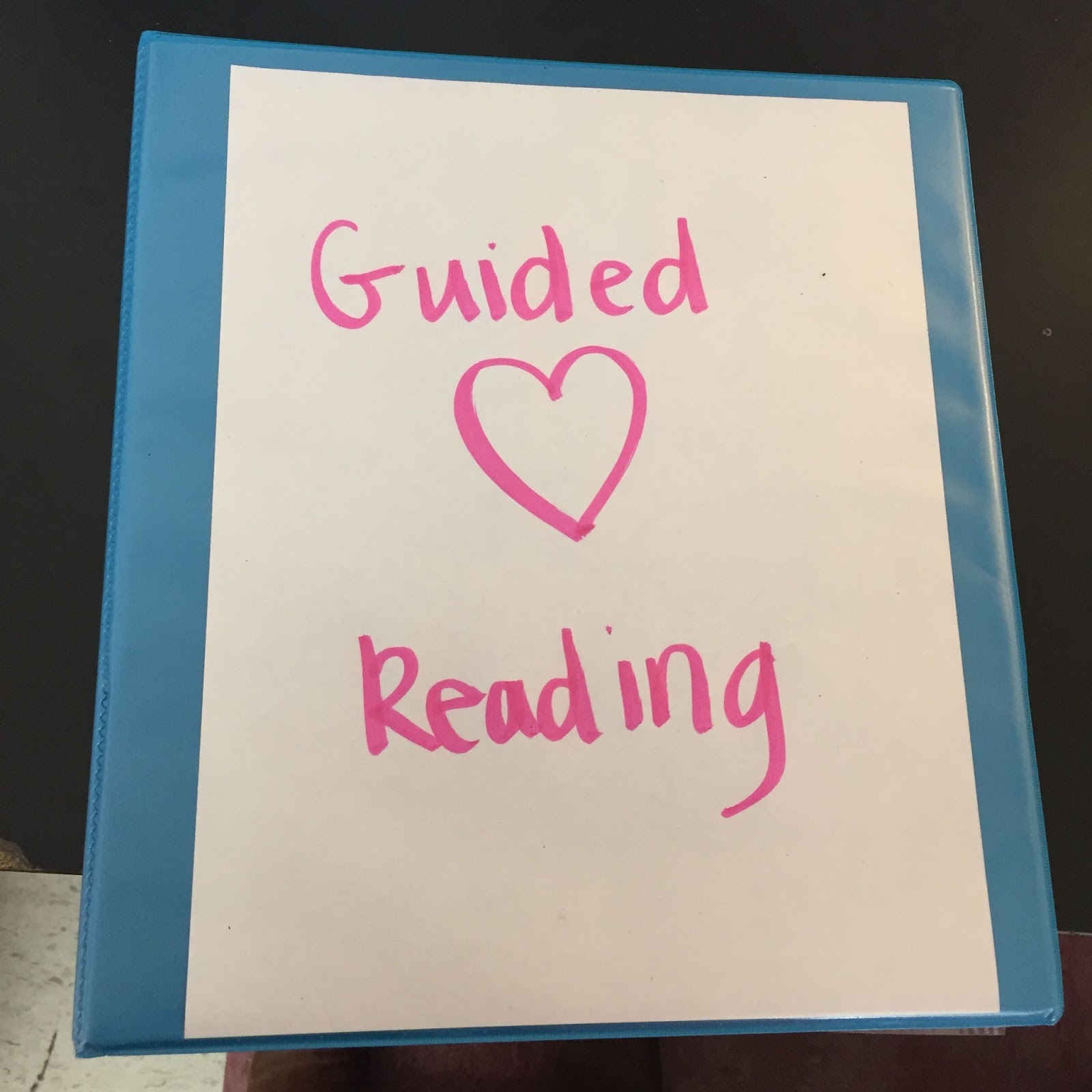
I began teaching guided reading again, this time in first grade! It's been cool to get to know another of the five plans from Jan Richardson. Now that it's been a few weeks, my records have fleshed out and I wanted to share my binder with you!


Here it is in all it's glory --
I'd rather write a blog post about it than make a pretty cover :-)


On the inside...front and back pockets:


Inside back pocket
I know it's strange to start with the end, but there's not much to report there. Just saving some word study materials I haven't gotten to yet; more on word study a few paragraphs down...

Inside front pocket
I keep everything I need now in this pocket - this week's lesson plan, this week's anecdotal notes, word study activities I'm planning to do today or tomorrow, and standards based anecdotal notes.


Lesson Plans, from The Next Steps in Guided Reading:


Anecdotal Notes This form, created by my awesome colleague and friend, Christine. One side of notes covers one group of kids - their names are listed where that white paper is, and then a box for each day of the week.


Word Study Materials - this week we're doing some picture sorting by medial vowel:


Anecdotals by Standard are next. (They are the stack of index cards that are paper clipped together.) Right now we're working on questioning. I just recently learned about this from an awesome fourth grade teacher over at Irving. You keep a stack of cards per standard and then annotate when kids attempt to use that strategy. In this case, it's questioning, so I was able to record the questions (or statements) kids shared and then grade them against a Standards-Based Rubric (4: Exceeds Standard, 3: Meets, 2: Approaches, 1: Beginning). Throughout the week, I'll keep more records of this to get a bigger picture.


Child's name is what is under the pen.

In the Rings:
First, I have a few mini-anchor charts in plastic sleeves:


I made these to use to prompt the students about various skills we are working on, so when I am ready to do that work, I take these out for their reference. This little trick is another one that Christine taught me. She began doing this as she built her Tier 3 lesson plans using Jennifer Serravallo's new book: The Reading Strategies Book.

Next I have more anecdotal notes - using a calendar is another way to think about them:


I just began a 1:1 intervention with a student who needs to build her knowledge of letter names (this is also in Jan Richardson's Book!) Since I am only working 1:1, I wanted to use a calendar to take notes of observations across our time together, so I just grabbed this freebie online today to use.


Strategies and Skills by Level - this is another resource in the Richardson's book and just wanted a quick reference to keep handy. The front page you see are all the strategies and skills children need to master at level A, behind it I have a few more levels, too. This way, when I'm planning the word study component of guided reading, it's easy to figure out what I should do!


Archived Lesson Plans - After I'm done with a sheet of plans, I hang on to them here, newest on top as a record of the work we've done.


Next section is for sight words:


I have two groups, so I have two sets of these charts, but up top you list each child's name on top of the list, and then when you assess their sight words, you can make notes here of how they're doing. I put a check mark if they are able to spell it correctly, and a "P" if I had to prompt them for support to write the word. If I notice that more than one student needs prompting, then I go back and reteach the sight word in question.


The next section is for archived Anecdotal Notes:


I keep the current notes I'm working on in the front cover, but then, as I finish them, they get filed here. What I love about this system is that when I go to an RtI meeting or need to update a parent or teacher about a child, I have so much information to potentially share with them just by looking through my notes!


I'm getting better at taking anecdotals the longer I keep with them, but some days I don't write things, and other days I focus too much on one student. Sometimes I take notes on the group as a whole, other days not. These notes are waaaay better than I used to do as a novice last year, and I'm sure I'll keep on improving with them the longer I keep working on them.

Assessment Data is collected in the last part of my binder:


When I say Assessment Data, I just mean running records, which are all saved here. But, I keep an Assessment Summary on top so I can see trends at a glance. This form below is just for one student, and lists running record scores and notes for each week I test him.


You see that I include the date, guided reading level of the text, the genre (fiction or nonfiction), whether the running record was hot (meaning the child read the book already before) or cold (it was the first time with the text. Then I have scores for Words Per Minute (WPM) and number of errors (which I haven't been taking because I keep forgetting to bring the calculator), their accuracy percentage, comprehension score, and overall reading level (Independent, Instructional, or Frustration) notes. That circled letter on the end of the line is the level I want to test the child on the following week, that way I don't have to analyze the information again - just a way to make myself more efficient.

On the bottom of the form is a rubric for determining the level that is from Fountas and Pinnell's Benchmark Assessment System.

So, that's my binder! What's in yours?
Any ideas to enhance what I've already got going on?
Please leave your ideas in the comments!

Wednesday, June 17, 2015

makeover madness!

As school ended this year, I was thinking about all the things I wanted to do this summer, including really working on my Teachers Pay Teachers stuff. Truth be told: I love to write and love to blog. I usually only do TpT stuff when I'm getting ready for a blog hop (side note: there's one this Friday!) and so I don't have lots going on with TpT. But, the #tptsellerchallenge is super motivating and I'm so happy to participate!


I created a Running Record freebie awhile ago and I just uploaded it as is - no cover, no TOU (I didn't even know about any of that stuff until just recently!) So, I've updated the freebie because I'm working on a complete set of running records to put up, too!

My freebie used to be just what you see to the left - just the resources. The thing is, I'm super good with creating quality stuff for TpT, but they don't look cute. So huge shout to Sparkling in Second, Third in Hollywood, Teach, Create, Motivate, and Peppy Zesty Teacherista for hosting!

If you like this freebie, you're going to love the complete collection of Running Records I'm currently working on. I've got the kinder and first grade ones done, and am diligently working on the rest! Stay tuned! And, check out my Running Records Tutorial if you want more information on them!

Have you checked out the #tptsellerchallenge? What are you redesigning this week for Makeover Madness? 

And just a reminder -- The Reading Crew is sponsoring Summer Blog Party beginning this Friday! Seventeen reading specialists share tons of resources for parents and teachers for beating the Summer Slide!


Hope to see you back this weekend!

Thursday, April 30, 2015

on your mark book study


Before we get into the conversation, here's how you participate in this virtual book study: Write a post about the book on your own blog. Link your blog post with mine below, and then read and comment on at least three other posts!


Now that that's out of the way, so glad you could join me for the On Your Mark Book Study! This book makes a case for Standards-Based Grading (SBG). The authors argue that this system is better for learning than the traditional grading scales that we may be used to from our days as a student.


What does SBG look like? Her's how I've come to understand it in the past six months: rather than having a traditional 5 grade (A, B, C, D, F) or 100 point (via a percentage grade) system, a SBG scale would have fewer, usually four indicators for describing learning: Exemplary, Proficient, Progressing, and Beginning. To grade an assignment with SBG, a rubric is needed to name indicators at each of the four levels, sometimes in one category, sometimes in a few. Take for example the rubric below. It was created by third grade teachers to assess student learning of CCSS RI 3.2: Determine the main idea of a text; recount the key details and explain how they support the main idea.


When you grade in this way, students might receive multiple grades for one standard - maybe they can name the main idea and use key words and score in the exemplary (4) category, but for details, they demonstrate work at the proficient level (3). The point with these rubrics is that teachers have defined indicators that demonstrate mastery towards the standards and students have a path toward exemplary work.

So with that being said, here are just a few of my thoughts about the text so far. I'll share a few quotes that stood out to me and then briefly discuss why I thought they were so powerful.

Few educators at any level today have any formal training on grading and reporting. Undergraduate courses in education rarely include in-depth discussions of grading. Graduate courses seldom explore the topic. And aside from sessions designed to help teachers learn how to use newly adopted grading software and online grading programs, professional development experiences hardly ever consider grading issues. As a result, school leaders and teachers typically know little about the different grading methods, the advantages and shortcomings of each, or the effects of different grading practices on students. (Brookhard, 2011a; Brookhart & Nitko, 2008; Stiggins, 1993; Stiggins & Chappuis, 2011) p. 10

The reason this stood out to me is that until SBG, I had never even thought that there might be different ways to grade. I never discussed this in Undergrad or Grad School, or with my colleagues. I guess it was just assumed that we all knew how to grade and make it reflect student learning. The more I come to understand about SBG, the more I see the grading I used to do as nonreflective of student learning. Not to say that my grades never reflected student learning - but definitely not to the extent it would today. Even as I teach my grad school classes now, everything is on a rubric. Every part of the papers I require give specific details to reach exemplary work. (Well, the first draft of my rubric isn't as good as the second, and the third version is going to be even better!) It's important to also keep in mind that it's a process, and developing sound rubrics takes time! (Unfortunately you usually don't realize the rubrics aren't working until you're grading the papers!)

Figure 2.1 shows a comparison between the typical letter grading scale and the percentage grading scale. Nearly two-thirds of the percentage grade scale describes levels of failure! is it necessary to distinguish this many levels of failure? Is it helpful to students? Does any teacher consider percentage grades in the 50s to denote modest failure and those in the teens or 20s  to represent more significant or extreme failure? Are unsuccessful students concerned about which of the sixth different levels of failure they achieved? (p. 27)

Prior to reading this book, I had never considered another way to think about grades, but yes, it's true! Why do we need all those levels of failure? I think it's because I've been having conversations about SBG for upwards of six months now, and I'm already sold, but having Guskey say it like this, and with the graphic below - I'm just left to wonder....Why? SBG makes so much better sense!


Many educators assume that because the percentage grading scale has one hundred classification levels, it is more precise than a scale with just a few levels (such as Excellent, Satisfactory, and Poor). But in the absence of a truly accurate measuring device, adding more gradations to the measurement scale offers only the illusion of precision.... In other words, with more levels, more students are likely to be misclassified in terms of their performance on a particular assessment. (p. 28-29)

Even when I was using a percentage scale to grade work, I usually didn't have a rubric. I was marking items right or wrong and then calculating a percentage to determine a grade to put in the books. Now that we are using rubrics to give students clear learning targets and for ourselves to give quality feedback, I can see that less is more. You wouldn't want 100 levels of proficiency! It would be too much! Even thinking of a gradient, say, for the levels of reading, perhaps Fountas and Pinnell's levels? There are 26 - I know I would have to look at the Continuum of Literacy Learning to know the differences between a level M reader and a level N. So, for creating rubrics to determine student progress, four levels seems perfect!

Guskey goes on to say,
By limiting the number of grade categories to four or five through an integer grading system, educators can offer more honest, sensible, and reliable evaluations of students' performance. (p. 33)
When combined with the common practice of grade averaging, a single zero can have a devastating effect on a student's percentage grade. The overall grade is unfairly  skewed by that one, atypical low score. To recover from a single zero in a percentage grade system, a student must achieve a minimum of nine perfect papers.... Ironically, the true culprit in this matter is not minimum grades or the zero - it's the percentage grading scale. (p. 31)

This just really struck me because of the fact it would take nine - NINE - perfect papers to recover from a zero. I knew zeros did damage, but I guess I had never thought about just how much! There was a student in my grad school class who just did not do one of the two papers that was required. Everything else about his performance was great, and he would have had an A in the class. But, with that zero, he ended up with a C. I can see how detrimental the zero is.

Like Guskey said, the real problem is the system of grading. Of course there are times when a child does not submit assignments, but then the teachers are unable to provide feedback because we have nothing to look at. With a SBG system, it is our job to get the work from the child, so then we can evaluate their learning.  I think this is a huge takeaway for me. SBG is always asking the question, What did the child learn?

So that's all for me today! We'll see you back in two weeks for our next post on chapters 3-6! Can't wait to hear about what you thought!


Tuesday, February 10, 2015

I am a Teacher of Conscience

"There comes a time when one must take a position that is neither safe, nor politic, nor popular, but he must take it because conscience tells him it is right."
-Martin Luther King, Jr.

In the past few weeks these are some of the things that have happened:

  1. One of my student bloggers wrote a blog (totally unprompted) about being nervous about the PARCC test.
  2. I read a story about a boy who asked for prayers at church one Sunday - prayers that he do a good job on his PARCC test. (Wish I bookmarked that link...)
  3. Jia Lee, a teacher from New York City addressed the Senate regarding the reauthorizing of NCLB. See her video here. (btw: Just watched that video again and the hair is standing up on my arms. Again.)
  4. A freshmen in high school set up this petition to open a conversation with legislation about High-Stakes Testing.
  5. More than 40 Superintendents in Illinois urged their legislators for a Common Core testing delay.

It's because of all these things and 100 more that I cannot remain silent any more. I share all of this with you, respectfully, and because morally-speaking, High-Stakes Testing really troubles me.

All this testing we are doing with children - it's not okay. I know I'm not the only one who believes this, and I know it's not easy to say something. If we want our profession back from Pearson and all the other people profitting on our children, we must speak up! Before Literacy Coach, I am a Michelle. I am a woman who is educated, who cares deeply for children, and who cannot silence the thoughts in my heart and mind any longer.

The testing has got to stop. Or in the very least, the conversation about testing has to get much, much louder.

I'll tell you why we're testing: Money. You know how much money Pearson is making on the PARCC test? Well, I don't know exact numbers, but it's a lot. A. LOT. How come in our profession, the professionals aren't trusted? I went to school for education. I have an advanced degree in literacy. I have worked with children for 12 years and have refined my practice day in and day out. Students don't need to take this test - now twice (once in March and then again in May) every year for my administration to know if I am an effective teacher.

Today I collaborated with three different grade levels in three planning meetings. At each one, we looked at student work - work specific to one standard with multiple opportunities for students to demonstrate learning - and we made conclusions about what misconceptions students had about each standard. We planned for reteaching and made rubrics that can communicate to parents if the child mastered the standard independently, with prompting, or not yet. This will be reflected in teacher instruction... tomorrow. We are the practitioners closest to our students. We are professionals. We know best.


Teachers, please join me in sharing your voice about High-Stakes Testing. In the very least, can you leave me a comment so I know I'm not alone?

Check out a great website: Teachers of Conscience. Be aware of what is going on in your local, state, and national political arena in regard to education. What I know now is teaching is far more political than I had ever thought as I grew up playing school in my basement dreaming of the day I would get to stand in front of a group of kids and teach them how to read and write.

Tuesday, January 27, 2015

growing fluent firsties

It's that time of year again - time for testing. Time for ACCESS for our ELLs and AIMS Web for our kinder and first grade kiddos. As someone who is new to elementary, I've been learning lots - I did ACCESS with kinders and have been looking at the AIMS Web fluency data with our first grade teachers. Today we were able to sit down and brainstorm some ideas for increasing the fluency in our little readers!

source

Of course, we have to start with the data. What follows are two reports we pulled from AIMS Web...

Here is the Tier Transition Report for one of our first grade classrooms:


This report shows the percent of the class at each of the three tiers. When we add the spring scores, we'll be able to compare both triangles (hopefully the Spring one will be all green!)

And below, you can see the Class Distribution by Scores and Levels Report:


In this classroom, we see four kids in Tier 3 and another five in Tier 2. Now that we have this information, what do we do with it?

But before we get there, let's remember that numbers can be deceiving. The report above only tells us how many words were read correct - there is no indication of the inflection of words or a rating on how their reading sounds - too fast? too slow? Like every assessment, there are always limitations, but used in conjunction with others, we can get a bigger picture of the whole child!

So, we've got this data, but now what? What do we do to help children improve their fluency? Here are just a few activities that are easy to implement!


Activities to Build Fluent Readers

Read Aloud
Obviously, firsties need to hear fluent reading every day. If you are not reading aloud to your kiddos, you have to find time to do so. If children never hear how a fluent reader reads, how will they know what kind of reading to mimic? This is only one of the many perks of reading aloud!


Repeated Readings
Another activity is to allow for repeated readings of short texts. This could be a poem or a part of a song or an excerpt from a text you've already read. Repeated Readings allow students to build their automaticity with text and their prosody. Automaticity refers to the ability to read quickly without thinking to much about decoding. Then, when that brain power is freed up, students can spend it thinking about the prosody, or the rhythmic, intoned qualities of the text. Readers read by tending to punctuation, dialog, and even read sentences in chunks, phrasing groups of 3-4 words together that go together. Allowing students to read short texts on a repeated basis allows for practice of inflection!

Click the picture to read more!

Reader's Theater
I'm sure you know all about Reader's Theater - scripts that are built from stories where students all read their "part" like a play. By practicing these together, students can build their automaticity so they can begin to read with inflection. Plus, these are meant to be performed for their classmates, so the Sense of Audience really revs up their engagement!

Tech Time!
If you have access to technology, students can use their devices to record themselves reading. They can do this over time and then reflect on and evaluate their progress. They can also create readings for their peers to listen to! One of my fave bloggers, Colleen over at Literacy Loving Gals also shared a great website today on her Instagram - Vocaroo! This is a website that can be used to record readings and it looks so easy to use!

I'm sure this is just the tip of the iceberg as far as fluency goes - what are your go-to activities to build fluent readers? Let's keep the conversation going...leave me a comment below!

Have a great night!

Friday, January 23, 2015

defining moments

The moment I because a Social Constructivist is as clear as day.

There I was, standing at the front of my classroom. My kids sat in groups of four. They had their basal (gasp!) out in front of them and we were reading a story from the book as a whole group (the horror!) It was some kind of traditional literature story about how the stars became in the night or something like that.


I would read a little, and then as prompted by the questions along the side of the book, stop periodically to ask the questions to the kids. I would pose a question, they would think and then turn and talk, and then we would share out.

This particular day I was modeling how to draw inferences as we read. The book told me to stop at some line and then share the inference listed. But there was a problem (well, there were a few, namely 1. basal reader, 2. whole group instruction, and 3. kids didn't do any independent reading, but I digress.) At that moment, my problem was that the inference that the book publishers were telling me to make made absolutely no sense to me. Zero sense. Zilch.


This happened in my fifth year of teaching when I was in the midst of my graduate work at ASU. I was learning about best practices in teaching reading and all the pieces suddenly fit together so perfectly.

Pearson or McGraw Hill or whoever was the publisher of this book was trying to instruct for me. I had no accountability to this book and this story, because it was all laid out for me. I just opened it up and read what it told me to. And usually it made sense, but in this moment when it didn't, it finally clicked. If I want to give my kids the best instruction, *I* have to be the one to figure it out and make meaning that makes sense to me. I have to be the one to prepare it for my kids!


I can't say that from that moment on I began doing what I'm doing now in year 12, but I was acutely aware that I had to construct my lessons myself.

I still used the basal, but I prepared how I was going to teach from the stories. Before I taught them, I sat down with that book - just the story, nothing else - and I read it through. I considered what my during reading strategy should be and picked places to stop and model what that would look like. I figured out if we would do any analysis after our first draft reading and planned that. 
The teacher who teaches kids each day should plan everything out. Not Pearson. Not McGraw hill. The practitioner.

Today, I am proud to be a part of a district that operates under a constructivist philosophy. In year 12, this makes sense to me and I believe it's what is best for kids.

But then I think of our first year teachers and how overwhelming it can be. I was lucky to be handed a basal in year one, and continue using it for five years. I got my feet wet, got my management down, had the kids do worksheets and everything was there for me. It was laid out and easy. That was all well and good, but it wasn't what is best for kids.

So to the newbies out there - the ones who are trying to get everything down in year one - the ones who are exhausted and have no time to do anything but work because on top of managing a classroom, you're also trying to learn how to teach a Reading and Writing Workshop - please know that you are giving kids amazing instruction, coming from what I believe is the hardest teaching philosophy out there. You're putting in all the labor to figure out how to model what good readers do and then give differentiated instruction in your guided reading groups, get kids to love to read and write, and then having them share. You're keeping anecdotal notes and using running records to inform your instruction, and writing Common Formative Assessments with your team, and grading them and then figuring out what kind of reteaching and enrichment needs to happen - you're doing all that work plus teaching three other content areas. I, on the other hand, opened a basal.

It's time for you to pat yourself on the back and appreciate all the work you've done, because it's outstanding and you're amazing.


Defining moments...mine was a sunny day in Phoenix during my fifth year of teaching. What is yours?

Saturday, December 13, 2014

thoughts on transfer

I've been working with my Tier 3 kiddo for over a year. I see him for 30 minutes a day for a Tier 2 intervention (either 1:1 or in a group of three depending on his schedule) and then for an additional 15 minutes 1:1. In our small group, he gets Leveled Literacy Intervention - reading fluency, comprehension, and word study. During his Tier 3 intervention, he gets Intensive Phonics.

In our Intensive Phonics, we've finally gotten to sight words. I've been teaching those explicitly in conjunction with guided writing. This week, transfer was highlighed to perfectly clear to me!

We all hope to teach our students strategies and skills that will transfer to their independent work. For example, when I was teaching middle school, I taught the reading strategies, hoping my students would begin to use them always when they read independently to better understand whatever they were reading. But transfer doesn't just happen because you teach something.

Case in point:


The way I've been doing sight words is by beginning with a review. I have my kiddo write the ones I've explicitly taught each day when we begin - kinda like a spelling test. Then, I'd instruct one or two more (by asking my kiddo, "What phonics rules does the word follow? What rules does it break?" and then using Jan Richardson's strategies for sight words.) Finally, we would end our 15 minutes with guided writing, where I'd have him write dictated sentences composed of sight words he has learned.

One day last week, he wrote his words and then we moved on to sentences. I dictated, "Did your friend come home with you?"

He wrote, "Did yor frend cum home yif you?"
(Sidenote: He hasn't learned your as a sight word or the vowel combo in friend.)

Now, this was after he came back from missing a week of school, so when I said, "Buddy, how come you missed that word, come?" He got all mad telling me, "Ms. Brezek, I was sick all those days and didn't practice!" I said, "But look back at the sight words you wrote - you spelled it right five minutes ago!" He was kinda shocked!

This is what I'm saying about transfer: My kiddo had the word in the way I was assessing - like a spelling test, but he did not have it when it was applied in another context. I can't assume that because I teach him how to spell a sight word that he will use it correctly in Writer's Workshop or as he writes for other purposes.


Now, if I'm a specialist meeting 1:1 with a kiddo and am reminded of transfer, what does this mean for the other interventions I've given, or for that matter, all the ways I have taught in the past?


I'm constantly reminded of these lessons and know that I will never know everything. I'm glad this happened this week, because I am no longer doing the long spelling-list type assessment. Now, he's writing many more dictated sentences and I'm going to assess his knowledge of sight words that way. And, I want to see his Writer's Notebook!

Did you learn something new this week? Leave a comment and join the conversation!

Sunday, November 16, 2014

guided writing #totesamazeballs

Do you use guided writing in your guided reading groups with kinder-second grade students? If you don't, this is an activity I believe you should implement...yesterday :-)

I just learned about guided writing this school year as I was investigating Jan Richardson's Guided Reading components. Currently, I am working with some second graders who are reading around a H-I level. The lesson plan for these kiddos is a two day plan, and guided writing falls into the second day of the lesson plan.

Guided writing involves me dictating a sentence to students for writing practice. We spend two days on the same book, and then towards the end of the second day, I will give students a sentence I have composed for them to write. When I am composing these sentences, I make them about the book we've read, and I craft the sentence very strategically. For example, I try and use the sight words that have been taught recently. I also pick words that students can write, but might have to stretch to get to the correct spelling. I might also be curious about their knowledge of a phonics rule - so in this case, I would choose a word that followed that pattern to use as an assessment of their phonics knowledge. These are some of the things I take into consideration as I craft the sentences.


Guided Writing is also a great time to coach on correct letter formation. My kiddos write on primary lined paper that I have stapled into little books - so they can learn correct formation of letters. So, when they are writing the sentences, I am able to watch them form letters and then coach them to better writing. I might notice they are forming letters in the wrong way or that they are using capital letters inappropriately. No matter what, it's a time to coach for improved writing!


We also talk about what goes at the beginning and end of the sentences - so children are constantly being reminded of capital letters and ending punctuation.

Have I sold you on Guided Writing yet?

Well, if I have, then you'll want to make sure you do one more thing before you have kids write your sentence - rehearsal. The kiddos have to practice the sentence orally before they write or they will forget it. So, what I do is ask them to set their pencils down, and then listen to my sentence.

The first time, I say it naturally. Kids listen. Then they say it with me a few times. Finally, I have them say it again, counting the words in the sentence. Then they are ready to write.


I didn't expect this activity to carry over into other areas, but last Thursday I watched it do so. The kids were working on determining the major and minor characters, what the character wants, and how characters respond to events in their stories. I did the first cycle with them on our first book, and then they finished. 


What I noticed when they went to the rug to work together was that they were developing their sentences orally, "Annie wants..." and then they were able to write their sentences on their matrix. I didn't even tell them to write in complete sentences: they just did! It was awesome to hear them rehearsing for what they were going to write!


So, guided writing is a worthwhile task to use in your guided reading lessons! For more information, check out Jan Richardson's book:


Are you following my blog? If not, make sure to do so! Coming next weekend, I'm participating in a great blog hop with some amazing Reading Specialists and Literacy Coaches. There will be lots of freebies and some giveaways, too!


Happy Sunday! Hope your football team isn't annoying you as much as mine are!

Wednesday, November 12, 2014

sight words

I've been doing a Tier 3 intervention with a kiddo for months....we worked together last year for about two months, and now this whole school year. I've been using Intensive Phonics with him, so he's learned tons of phonics rules! 42 sounds, silent e, adjacent vowels, R-controlled vowels, Pig-Pen sounds (oi/oy, au/aw, etc) and more that are slipping my mind right now.

We finally got to sight words and I've learned something new that I thought I should share with you!

But before I get to that... how do you all keep anecdotals on sight words? I gave him a quick spelling test today, keeping track of what he spelled correctly and noting his errors - that way I will know what I need to teach. Then tomorrow, I'm going to quiz him on the words he learned today, and then just keep track on a chart. Here's what mine looks like so far (I've only kept info on it for two days...)


Okay so back to what I learned today:

This program teaches kids to look for what is *right* about the sight words. Take for example, the word come...

There are three sounds in this word: /c/ /o/ /m/.

The initial consonant follows the rule - it's a hard c, like usual.
The silent e on the end is following the silent e rule - well, part of it (it doesn't make the o long...).
Which means the ending sound, /m/, is also correct.

So then, the reason we have to teach this as a sight word is because the o says short u, when it should say long o.

Today, my kiddo and I looked carefully at two words: do and has. We talked about what is right about them (do=initial sound; has= initial sound, short vowel). Then I taught them that there are irregularities with these words, which is why we have to memorize them and learn them by sight.

We then used Jan Richardson's four routines for sight words:

1. What's missing
2. Mix and Fix
3. Table Writing
4. Notebook Writing

Finally, I began a bag of word cards for him to take and practice.


I'm hoping all of this helps! He's gotten so much better about writing words he doesn't think he knows, and it's in large part to Intensive Phonics. This is a great Tier 3 Intervention...and I think you can see more about it here. (One of my former principals shared it with me...I'm pretty sure this is the same!)

What tricks do you have for sight words? I'd love to enhance my instruction even more, so leave a comment and let me know!
Related Posts Plugin for WordPress, Blogger...