Pages

Showing posts with label guided reading. Show all posts

Tuesday, May 24, 2016

balanced literacy classroom essentials

As the school year is wrapping up, I have been looking around at all the things I have in my classroom and was feeling so thankful that our district understands the importance of these items that truly make a Balanced Literacy Classroom flourish. This time of year, I'm sure you're like me in that you begin to think ahead, to envision your next year and everything you're going to do to make it better.

If you'd like to think about shopping, here's what I'd put in my cart for a perfect classroom:

The Library
I read a great quote once, about how the size of the library reflects the teacher's vision for literacy instruction. Totally agree. The bigger the better. Beg, borrow, steal. Ask your principal for money for books! Post ads on Craig's List, use Donor's Choose, ask in neighborhood facebook groups, just make it YUGE!


A Rug & Gathering Space

Again, ask your principal. You need a rug so you can sit together as a family and build community and talk about books. If asking doesn't get you anywhere, use Donor's Choose and get something gorgeous!


An Easel

You have to have one of these for teaching: having your anchor chart paper on one side, a magnetic whiteboard on the other. This one is awesome and has little buckets below, too, for storage. Just the other day I was making that chart with an intervention group and one of the firsties said, "I love this chart of words!" So, you can use this whole group or with a small group, but it's an essential!


Conferring Table

You have to have one of these kidney tables if you plan on conferring with kiddos over reading and writing. *Absolutely essential.


Benchmark Assessment System

You'll need this to figure out where kiddos are, what instruction to give them, and then to monitor their growth. There are many different tools like this, but Fountas and Pinnell is my favorite!


Magnetic Letters

Children, especially the youngest ones, need to manipulate items to learn best. You need these magnetic letters in your life so they can do just that. Also, pick up some little bowls by the tupperware at Target - you need to have everything prepped and ready before your lessons or you'll waste 5 minutes just taking the letters out!


Organizing Bins
Your life will be much easier if you have a little container for each child where they put their things. These have materials for our intervention group, but kiddos can also keep their Readers and/or Writer's Notebooks and Just Right books in them, too! Here's the ariel (sp?) view:


Literacy Idols
And of course, where would we be without our idols? I love having my people with me when I am stuck or maybe when someone else has a question or maybe just for inspiration! Calkins, Atwell, Fletcher, Richardson, Miller, and all the rest are at my side when I need them.


Don't forget some Sketcher Markers, notebooks, and good pens!
What am I missing? Leave a comment to share!

Saturday, May 21, 2016

strategies not levels

I have been doing some intervention work with a few first graders since December. Now it's May and time for benchmark assessments to see how much they grew. My little kiddos unfortunately did not make it to grade level, but there's so so much to celebrate!


So here she was reading a level D Nonfiction book. She confuses her b's and d's and usually I would prompt her with this little organizer, but because it was a benchmark, she had to ask for this tool rather than me handing it to her:


But do you see how I was scripting what she was saying? Then she says to herself, "Does that make sense?" and she went on talking aloud to herself saying, "No, it doesn't."

As a Reading Specialist, this is what I want her to do, to problem solve on her own, without my help, to use strategies I prompt her with in guided reading on her own. Even though this means she frustrated on level E, which is a beginning-of-first-grade level, I feel so proud in what she demonstrated to me. Not only did she verbalize the semantic cueing system, she also:
  • read punctuation, dialog, and bold words with proper inflection
  • cross-checked to pictures and words
  • looked back at the title or another page she had already read to help her solve a new word
  • substituted words that made sense
  • retold the story by looking back across the text
On the level E book, she had a lot of errors, and two repeated with the following:


After it was all said and done, I taught on these miscues. I had her say with and we paid attention to where her tongue was on the /th/ - buzzing by her teeth. Then we said the nonsense word wif - and we noticed that her tongue was in the back of her mouth to say /f/.

That's the purposeful kind of conversations that come from running records. Oh, super cute, she miscued: loof for loose. At one point I was looking to see if she had lost all her front teeth!

I've just been reflecting on all this because I know we have these benchmarks to attain, but for me, it's never the level. This little kiddo did so many things that made my heart swell with pride - and those strategies she has now are hers - her strategies to take her up the levels to more complex text, especially as I think about how kids have to get over that hump from easy picture books to the beginning chapter books around levels J-K-L.

Also, we have to remember that all children develop in their own time. While this particular kiddo may only be at level E right now, she may come back and then have instruction click in second grade and then all of a sudden she's made four levels of growth in four months.

The strategies are what is important. Not the reaching for higher and higher levels.

Your thoughts?

Wednesday, January 20, 2016

guided reading binder - take a peek!

I began teaching guided reading again, this time in first grade! It's been cool to get to know another of the five plans from Jan Richardson. Now that it's been a few weeks, my records have fleshed out and I wanted to share my binder with you!


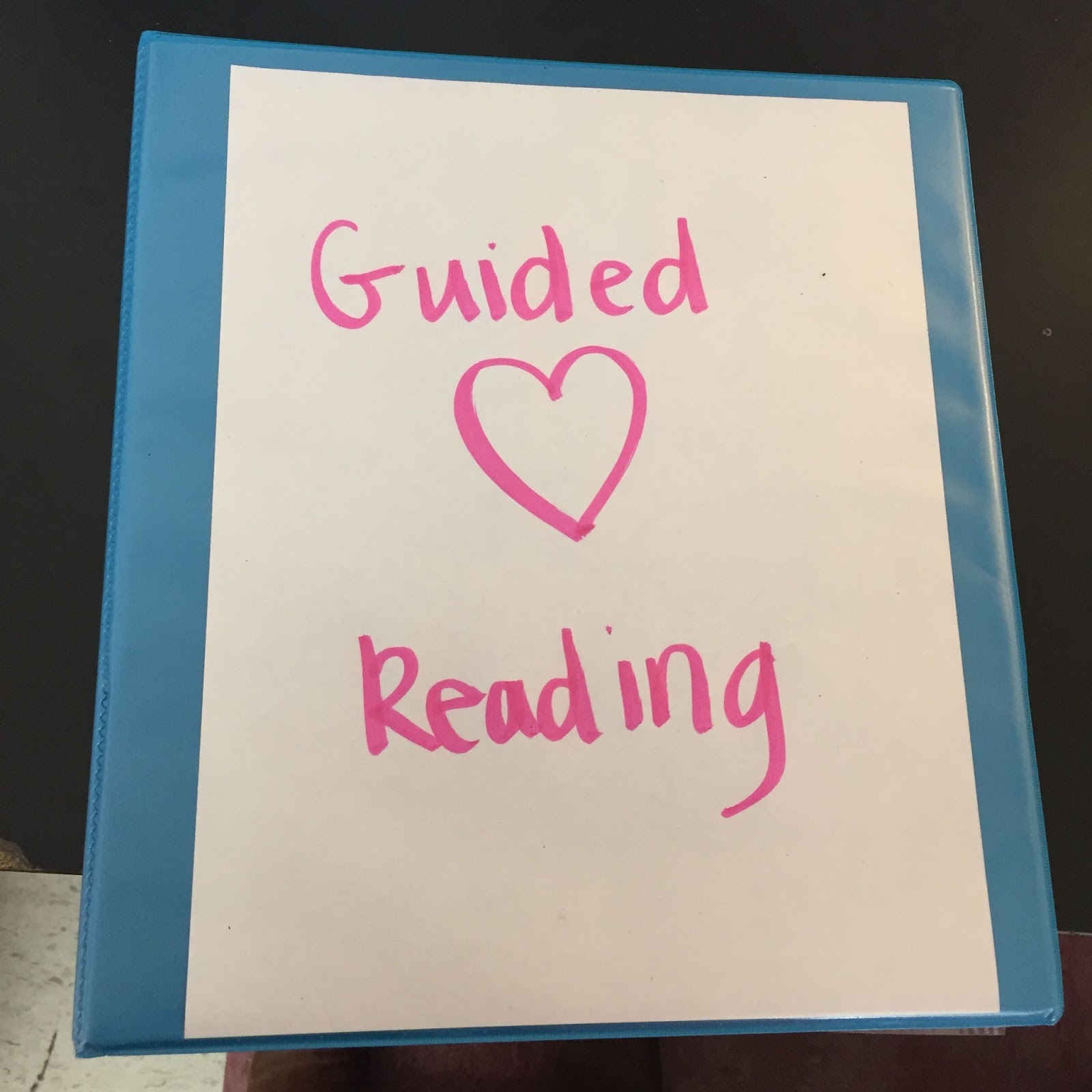
Here it is in all it's glory --
I'd rather write a blog post about it than make a pretty cover :-)


On the inside...front and back pockets:


Inside back pocket
I know it's strange to start with the end, but there's not much to report there. Just saving some word study materials I haven't gotten to yet; more on word study a few paragraphs down...

Inside front pocket
I keep everything I need now in this pocket - this week's lesson plan, this week's anecdotal notes, word study activities I'm planning to do today or tomorrow, and standards based anecdotal notes.


Lesson Plans, from The Next Steps in Guided Reading:


Anecdotal Notes This form, created by my awesome colleague and friend, Christine. One side of notes covers one group of kids - their names are listed where that white paper is, and then a box for each day of the week.


Word Study Materials - this week we're doing some picture sorting by medial vowel:


Anecdotals by Standard are next. (They are the stack of index cards that are paper clipped together.) Right now we're working on questioning. I just recently learned about this from an awesome fourth grade teacher over at Irving. You keep a stack of cards per standard and then annotate when kids attempt to use that strategy. In this case, it's questioning, so I was able to record the questions (or statements) kids shared and then grade them against a Standards-Based Rubric (4: Exceeds Standard, 3: Meets, 2: Approaches, 1: Beginning). Throughout the week, I'll keep more records of this to get a bigger picture.


Child's name is what is under the pen.

In the Rings:
First, I have a few mini-anchor charts in plastic sleeves:


I made these to use to prompt the students about various skills we are working on, so when I am ready to do that work, I take these out for their reference. This little trick is another one that Christine taught me. She began doing this as she built her Tier 3 lesson plans using Jennifer Serravallo's new book: The Reading Strategies Book.

Next I have more anecdotal notes - using a calendar is another way to think about them:


I just began a 1:1 intervention with a student who needs to build her knowledge of letter names (this is also in Jan Richardson's Book!) Since I am only working 1:1, I wanted to use a calendar to take notes of observations across our time together, so I just grabbed this freebie online today to use.


Strategies and Skills by Level - this is another resource in the Richardson's book and just wanted a quick reference to keep handy. The front page you see are all the strategies and skills children need to master at level A, behind it I have a few more levels, too. This way, when I'm planning the word study component of guided reading, it's easy to figure out what I should do!


Archived Lesson Plans - After I'm done with a sheet of plans, I hang on to them here, newest on top as a record of the work we've done.


Next section is for sight words:


I have two groups, so I have two sets of these charts, but up top you list each child's name on top of the list, and then when you assess their sight words, you can make notes here of how they're doing. I put a check mark if they are able to spell it correctly, and a "P" if I had to prompt them for support to write the word. If I notice that more than one student needs prompting, then I go back and reteach the sight word in question.


The next section is for archived Anecdotal Notes:


I keep the current notes I'm working on in the front cover, but then, as I finish them, they get filed here. What I love about this system is that when I go to an RtI meeting or need to update a parent or teacher about a child, I have so much information to potentially share with them just by looking through my notes!


I'm getting better at taking anecdotals the longer I keep with them, but some days I don't write things, and other days I focus too much on one student. Sometimes I take notes on the group as a whole, other days not. These notes are waaaay better than I used to do as a novice last year, and I'm sure I'll keep on improving with them the longer I keep working on them.

Assessment Data is collected in the last part of my binder:


When I say Assessment Data, I just mean running records, which are all saved here. But, I keep an Assessment Summary on top so I can see trends at a glance. This form below is just for one student, and lists running record scores and notes for each week I test him.


You see that I include the date, guided reading level of the text, the genre (fiction or nonfiction), whether the running record was hot (meaning the child read the book already before) or cold (it was the first time with the text. Then I have scores for Words Per Minute (WPM) and number of errors (which I haven't been taking because I keep forgetting to bring the calculator), their accuracy percentage, comprehension score, and overall reading level (Independent, Instructional, or Frustration) notes. That circled letter on the end of the line is the level I want to test the child on the following week, that way I don't have to analyze the information again - just a way to make myself more efficient.

On the bottom of the form is a rubric for determining the level that is from Fountas and Pinnell's Benchmark Assessment System.

So, that's my binder! What's in yours?
Any ideas to enhance what I've already got going on?
Please leave your ideas in the comments!

Friday, January 23, 2015

defining moments

The moment I because a Social Constructivist is as clear as day.

There I was, standing at the front of my classroom. My kids sat in groups of four. They had their basal (gasp!) out in front of them and we were reading a story from the book as a whole group (the horror!) It was some kind of traditional literature story about how the stars became in the night or something like that.


I would read a little, and then as prompted by the questions along the side of the book, stop periodically to ask the questions to the kids. I would pose a question, they would think and then turn and talk, and then we would share out.

This particular day I was modeling how to draw inferences as we read. The book told me to stop at some line and then share the inference listed. But there was a problem (well, there were a few, namely 1. basal reader, 2. whole group instruction, and 3. kids didn't do any independent reading, but I digress.) At that moment, my problem was that the inference that the book publishers were telling me to make made absolutely no sense to me. Zero sense. Zilch.


This happened in my fifth year of teaching when I was in the midst of my graduate work at ASU. I was learning about best practices in teaching reading and all the pieces suddenly fit together so perfectly.

Pearson or McGraw Hill or whoever was the publisher of this book was trying to instruct for me. I had no accountability to this book and this story, because it was all laid out for me. I just opened it up and read what it told me to. And usually it made sense, but in this moment when it didn't, it finally clicked. If I want to give my kids the best instruction, *I* have to be the one to figure it out and make meaning that makes sense to me. I have to be the one to prepare it for my kids!


I can't say that from that moment on I began doing what I'm doing now in year 12, but I was acutely aware that I had to construct my lessons myself.

I still used the basal, but I prepared how I was going to teach from the stories. Before I taught them, I sat down with that book - just the story, nothing else - and I read it through. I considered what my during reading strategy should be and picked places to stop and model what that would look like. I figured out if we would do any analysis after our first draft reading and planned that. 
The teacher who teaches kids each day should plan everything out. Not Pearson. Not McGraw hill. The practitioner.

Today, I am proud to be a part of a district that operates under a constructivist philosophy. In year 12, this makes sense to me and I believe it's what is best for kids.

But then I think of our first year teachers and how overwhelming it can be. I was lucky to be handed a basal in year one, and continue using it for five years. I got my feet wet, got my management down, had the kids do worksheets and everything was there for me. It was laid out and easy. That was all well and good, but it wasn't what is best for kids.

So to the newbies out there - the ones who are trying to get everything down in year one - the ones who are exhausted and have no time to do anything but work because on top of managing a classroom, you're also trying to learn how to teach a Reading and Writing Workshop - please know that you are giving kids amazing instruction, coming from what I believe is the hardest teaching philosophy out there. You're putting in all the labor to figure out how to model what good readers do and then give differentiated instruction in your guided reading groups, get kids to love to read and write, and then having them share. You're keeping anecdotal notes and using running records to inform your instruction, and writing Common Formative Assessments with your team, and grading them and then figuring out what kind of reteaching and enrichment needs to happen - you're doing all that work plus teaching three other content areas. I, on the other hand, opened a basal.

It's time for you to pat yourself on the back and appreciate all the work you've done, because it's outstanding and you're amazing.


Defining moments...mine was a sunny day in Phoenix during my fifth year of teaching. What is yours?

Sunday, November 16, 2014

guided writing #totesamazeballs

Do you use guided writing in your guided reading groups with kinder-second grade students? If you don't, this is an activity I believe you should implement...yesterday :-)

I just learned about guided writing this school year as I was investigating Jan Richardson's Guided Reading components. Currently, I am working with some second graders who are reading around a H-I level. The lesson plan for these kiddos is a two day plan, and guided writing falls into the second day of the lesson plan.

Guided writing involves me dictating a sentence to students for writing practice. We spend two days on the same book, and then towards the end of the second day, I will give students a sentence I have composed for them to write. When I am composing these sentences, I make them about the book we've read, and I craft the sentence very strategically. For example, I try and use the sight words that have been taught recently. I also pick words that students can write, but might have to stretch to get to the correct spelling. I might also be curious about their knowledge of a phonics rule - so in this case, I would choose a word that followed that pattern to use as an assessment of their phonics knowledge. These are some of the things I take into consideration as I craft the sentences.


Guided Writing is also a great time to coach on correct letter formation. My kiddos write on primary lined paper that I have stapled into little books - so they can learn correct formation of letters. So, when they are writing the sentences, I am able to watch them form letters and then coach them to better writing. I might notice they are forming letters in the wrong way or that they are using capital letters inappropriately. No matter what, it's a time to coach for improved writing!


We also talk about what goes at the beginning and end of the sentences - so children are constantly being reminded of capital letters and ending punctuation.

Have I sold you on Guided Writing yet?

Well, if I have, then you'll want to make sure you do one more thing before you have kids write your sentence - rehearsal. The kiddos have to practice the sentence orally before they write or they will forget it. So, what I do is ask them to set their pencils down, and then listen to my sentence.

The first time, I say it naturally. Kids listen. Then they say it with me a few times. Finally, I have them say it again, counting the words in the sentence. Then they are ready to write.


I didn't expect this activity to carry over into other areas, but last Thursday I watched it do so. The kids were working on determining the major and minor characters, what the character wants, and how characters respond to events in their stories. I did the first cycle with them on our first book, and then they finished. 


What I noticed when they went to the rug to work together was that they were developing their sentences orally, "Annie wants..." and then they were able to write their sentences on their matrix. I didn't even tell them to write in complete sentences: they just did! It was awesome to hear them rehearsing for what they were going to write!


So, guided writing is a worthwhile task to use in your guided reading lessons! For more information, check out Jan Richardson's book:


Are you following my blog? If not, make sure to do so! Coming next weekend, I'm participating in a great blog hop with some amazing Reading Specialists and Literacy Coaches. There will be lots of freebies and some giveaways, too!


Happy Sunday! Hope your football team isn't annoying you as much as mine are!

Monday, October 27, 2014

guided reading rules!

I've been using Jan Richardson's The Next Steps in Guided Reading this school year to make my guided reading lessons even better! It's been about 4 or 5 weeks that I've been teaching a group of second graders. Their Instructional Reading level is G-H, so we're using the Early Lesson Plan. The following is what is involved.

First, students in the class I teach each have their own book bin, which includes their Reader's Notebook and the following:


Each day when I walk in, they grab their book bins and meet me at our table. The lesson plan is for two days, so I usually do an Instructional level text on Monday and Tuesday, then a grade level text on Wednesday and Thursday, and then I assess on Friday with running records. I follow the same plan on Mon-Tues and Wed-Thurs, but just with two different books. Here's what we do on Day 1!

Sight Word Writing (1-2 minutes)
This is just meant as a quick assessment. Sometimes it's a pre-assessment, other times I check their knowledge of sight words I had previously taught. Students come to group and take out their whiteboards, erasers, and markers, and then use their book bins to keep their writing private. I take anecdotal notes on a chart and use it to inform what words to teach next.


Book Introduction (4-5 minutes)
The book introduction involves three parts, so don't waste time with it! First, give a gist statement about the book. In one or two sentences, you will tell students what they are going to read about and learn about.

Next, students take 1 minute to picture walk to build their knowledge of the story. They just whisper read the pictures to themselves.

Finally, I explicitly teach vocabulary to students. I only pick one or two words, and I only pick words that cannot be determined with pictures or context clues. Ideally, I want Tier 2 words that will be useful in other contexts.
  • When teaching vocabulary, I will tell the the word and then ask them to say it. I will have them stretch out the sounds and then figure out the first letter, blend, or digraph. Then I'll tell them what page it is on and ask them to turn to that page and find it. Once we find the word, the kids run their fingers under the word to read it.

Student Reading with Teacher Prompting (8-10 minutes)
This part is the heart of the guided reading lesson. For the bulk of the time, students are whisper (or silent) reading their books. The teacher then, listens in to each student, prompting them to improve their reading.


Prompting isn't all that easy. It's like you want to give the kids scaffolds to improve their reading without telling them the words or phrases they are trying to solve. Here are sample prompts for three different areas:

Decoding
  • Do you see a part of that word that you know?
  • Does the picture match what you just read?
  • Look at that word again - there's no 'n' in that word...can you try it again?
Fluency
  • Make that line sound like the character would say it.
  • Listen to me read this phrase/sentence/paragraph. <read to student> Did you hear my my voice inflected/went up/went down/changed for dialog? You try and make it sound like that.
Comprehension
  • What do you think might happen next?
  • <after reading> Tell me what that was mostly about.

In addition to students reading and teacher prompting, the teacher is also taking anecdotal notes. Here, I write down things I notice, strategies the kids are using, strategies they are not, noting when they finally begin using a strategy that I had taught them previously. These notes are awesome when conferences come around - after doing them for three or four weeks, you can definitely see trends!


Sight Word Direct Instruction (2-3 minutes): 4 Parts

  • What's missing? Show the kids the new word on a whiteboard. Have them spell it with you. Then, turn the word to you and erase two or three of the letters. Ask the first student, "What's missing?" Add the letters back and erase different letters. Ask the next student the same thing. Continue this way so each child has a turn. This forces kids to read the word left to write, building knowledge of the letters and the order of them.
  • Mix and Fix: Give kids the sight word in magnetic letters. Instruct them to 'mix' the letters and then fix them, while spelling the word aloud. Have kids do this three times.

  • Table writing: Kids use their finger to write the word on the table.
  • Writing on a whiteboard: Show the kids how to write the word. This is a great time to model how to correctly write letters and show them how big or small they should be. After you show them, tell them to write the word, spelling and saying it, until you say stop. Give feedback to kids on their writing if needed.

Word Study (3-4 Minutes)
There are four different activities you can do here. I'm going to talk about the Analogy Chart:


For the analogy chart, students spell new words by analogy. I have them write two anchor words (these should always be words they can spell easily). Then, I dictate a new word. Kids have to say it aloud twice and tap it out on their arms to help them decide which anchor word it sounds like. Then, they write it in the correct column.

Do you use the same lesson plan template? Anything similiar about these activites and your guided reading? Please leave a comment and share!

I'm super tired...must sleep!

Goodnight!

Wednesday, October 15, 2014

instructional level or grade level...that is the question

A few weeks ago at the Illinois Reading Council (IRC) conference, I ended up in two sessions where the speakers (One of them: Tim Shanahan) were talking about teaching guided reading with grade level text. Their point was that if we only teach on instructional level, when will the kids be exposed to grade level reading? Their other point: In a guided reading group, there are only 4-6 kids, so you can provide enough scaffolding to help them read that grade level text.

So, I've tried this out with my guided reading group (only once so far). They are reading at a level G-H, and grade level for this time of the year is J. Now, this isn't a huge jump, but I can totally tell when they're reading the grade level text - and so can they. The amount of words on the page is way more, the text is smaller, there are less pictures...etc.

This week, we've been reading Nonfiction. We did the instructional level text "Life Cycles" yesterday and today. Tomorrow and Friday we're going to be reading a level J book, "The Life Cycle of the Owl" which is more of the same, but goes into much more detail about the owl's life cycle.

I'll report back later this week with the results, but in the meantime, what are your thoughts about this? One book a week on instructional level, and the other on grade level?

Don't be shy....leave a comment!


Goodnight!

Saturday, July 12, 2014

rainy day thoughts about school starting

Good rainy morning to you! Sorry this post is late going up....my cousin is visiting from the suburbs so we were busy riding bikes around the city last night:


Is it raining where you are? One of the things I love about my apartment is that it is on the second floor, so I get to sleep with my windows open. I love waking up to the sunshine streaming through, or in this case, the gentle music of the rain falling. Fortunately, I don't have any outside plans that the rain could impose on, so I welcome it this morning!


I was thinking a little yesterday about going back to school, and the fact that I don't have my own class again. And then I was thinking about if I were going back to a middle school class, what I would do differently knowing what I know after coaching for a year in elementary school. So here are just a few things that you might consider to enhance your middle school literacy instruction if that is where you'll be next year!

First, as I happened on the test data from the last standardized test, I would make a list of the kids who didn't meet the standards. I would keep this list in a planner somewhere, and then after getting to know the kids I would adjust it based on what my "kidwatching" skills told me. I would basically be trying to figure out who are my most vulnerable readers, and then I would give each of them an assessment like the Fountas and Pinnell Benchmark Assessment to determine more. 


This assessment is going to give you information about words read per minute, accuracy, fluency, and comprehension. Within comprehension, you'll be able to see how they do with retell, questions about the text (craft and structure) and questions about the text (inferential). It really gives a lot of information, so this is where I'd start with my readers I was most concerned with.


You might be wondering how you'd have time for all that assessment when you've got a room full of kids. Well, I'd also be teaching them how to do independent reading for the first month of school. So, my lessons would be about management and I'd keep them brief, so the kids could get to the heart of the work - the reading! If you have the Lucy Calkins Curriculum, these lessons are in the first unit - Building the Reading Life. If you do not have this curriculum, I highly suggest buying this book:


Couple of things: I know it says it's for guiding readers and writers grades 3-6, but it will totally work for middle school. Anyways, this book is awesome, and full of great ideas, but chapter 9 is the chapter you'll want to follow along with. It will lay out lesson plans for the first 20 days of independent reading. I always started my middle school class with these lessons, and I highly recommend them!

So, when can you assess those kids? Well, get your kiddos reading, and then you'll have time while they're busy working to test a kiddo here and there. I would also find more time throughout the day - during homeroom, maybe during a plan period - to get them all done. Like I said, the information you'll get from the assessment will be fab!

The last thing I'd do in the beginning of the year is talk to my admin about getting guided reading books - short, leveled texts - that I could use to give specific guided reading instruction to my kids who need that extra support. The middle school I was in didn't have much in the way of leveled books, so I'd figure out a way to get what I needed - donor's choose, borrowing from an elementary school, maybe getting money from the school budget, I'm not sure. All I know is that I'd need books to give them more tailored instruction!

Anyways those are just a few things I was thinking as I was deciding what to write about today. I'm sure when more come to me, I will share, especially because I want to share about guided reading lessons, too....since my work bestie taught me so much about it!

For now though, that is all since I have a date at hot yoga and then for High Tea at the Drake! Hopefully the rain will stop long enough for us to get to the bus stop!

Have a great day!

Related Posts Plugin for WordPress, Blogger...