Pages

Showing posts with label vocabulary. Show all posts

Saturday, October 5, 2013

Words Their Way Implementation in Kinder

Last week I was so happy to show Ms. Optie how to do Words Their Way with her Kinders. Now, I've never taught kinder before, so that was new for me, but with Melinda's knowledge about kinder + my knowledge about WTW, we made a fab team! 


So on Monday, we started by introducing the kids to the sounds and the picture cards. Our kinders aren't reading text yet, but that doesn't mean they can't read pictures! We worked on the sounds /b/ (bell), /m/ (mouse), /r/ (ring), and /s/ (sun). Each of the four sounds has an anchor word, which I listed in parenthesis.

We started by showing the kids how to say the sounds, like this: "Mmm, mmm, mouse. Buh, buh, bell. Rrr rrr, ring. Sss, sss, sun." Here you can see me telling the kids, "My turn..." and I model, and then I point to them and say, "Your turn..." and they repeat.


Monday was also the day that we intro-ed all the words. There were some pictures that all the kids didn't know, like rake and roof. So we did a lot of gestures - using our rake, and making a roof with our hands. The gestures and acting out are good for the ELL kids, but also just engaging, good instruction for all the kids.

After we finished all together at the meeting space by the Smart Board, kids went back to their seats to cut out and then do their first sort. Looking back, we probably gave them too many directions all at once. We should have had them cut, then come back, so we could SHOW them how to do the sorts.


Here is one of Melinda's kiddos sorting for the first time. It was helpful to have the kids point and touch each picture as they said their sounds and words. Also, notice that the headers with the letter and anchor picture are in yellow. The kids know that they yellow cards go up at the top.


On Monday, after we finally finished sorting, we had kids draw pictures of words with the sounds. Again, we didn't do directions well enough (chalk that up to my inexperience with kinder...but I'm learning!) but the kids did some great work! Here's one boy doing a drawing:


Here's Sophie's /s/ words. I sat with her and asked her what each picture was and wrote those words out for her. Notice that she drew circles....I explained to her that circles was an oddball because even though she heard the /s/ sound, it was spelled with a c, so we crossed it off. But I was so excited for the see-saw, since that was not a picture in the word sort! Extension of learning - awesome!


And here is Erica's work. Let's see if I can remember everything: a boy, a bunny, a scooper, (forgot the next B word), and a road. Such smart thinking! Scooper wasn't in our picture sort. So proud of her!


Moving on to Tuesday, the kids began with the sorting again. One of the goals with WTW is to develop speed and automaticity, so we were well on our way to figuring out the procedures for the sorts.


On Tuesday (or maybe this was Wednesday?) after we did the sorting, we brought some guided reading books (Fountas & Pinnel,  level B) so kids could look in the books for words that began with the words we were studying that day. Each child got a book and a paper to write words they found.


The kids had to differentiate between initial letter and finding the letters in the middle of the words. They were able to find the words and make the connection of word study to authentic books. Well, I guess they're leveled readers, but an important part of WTW is that the kids understand that all the sorting, comparing, contrasting, and constructing of knowledge is applied in books.


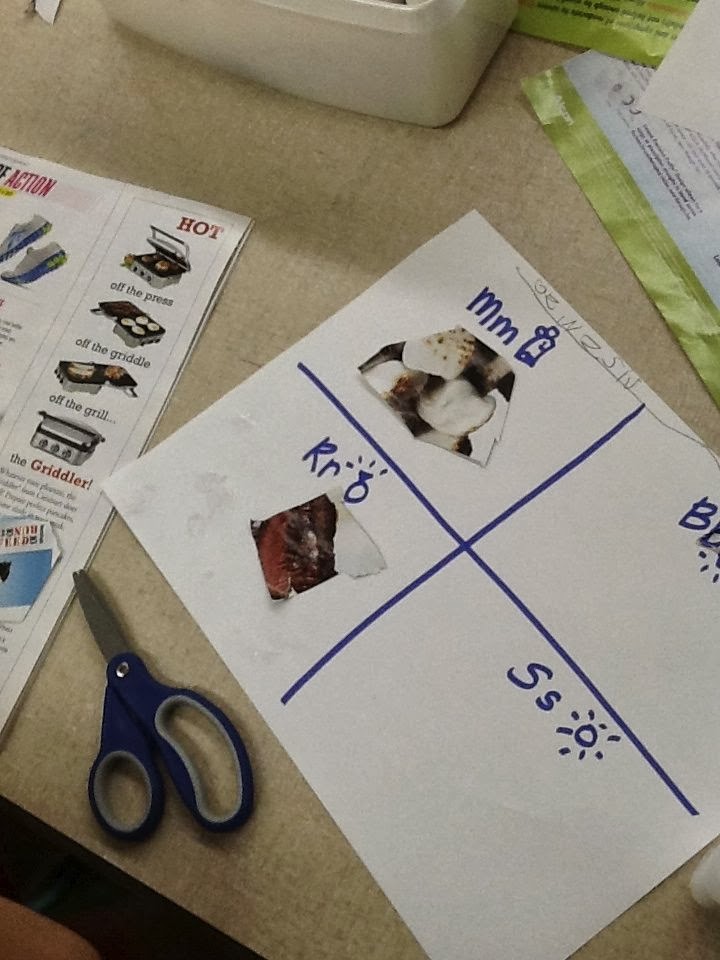
On the next day, I think Wednesday, we began again with a word sort. After, we had the kids using magazines to find pictures of words that started with each of the sounds. They pasted them on a page that had four squares, each with the letters and the anchor picture. I think the novelty of the magazines worked well, but....

Marshmallows and Ribs

It was like a magazine explosion with the kids! Scraps everywhere, but they were having fun!


So cute - look at this little guy with his four pictures: mouth, can't remember the b word, red, and forgot the s word. He was so excited....and so was I!


We finished up on Friday by doing a sort first. Here is one of our ELL teachers, Ms. Escobedo, working with one of the kiddos she services:


It was awesome because Gissel said that she could totally see growth in the kids over the course of the week! And I noticed it too. By the end of the week, they knew that the yellow cards went at the top, they knew how to sort, how to say the sounds and letters. Joey stopped asking me, "Ms. Brezek, where does this word go?" (To which I always replied, "Joey, say the word! What sound do you hear?")

After our last sort, I was ready to find out how much the kids learned, so we did some "secret" practice.

I asked Melinda how we can separate them since I wanted them to do their own work. We knew this was assessment, they thought it was just a secret game.

Each child got the chart below on paper....


Then we showed them 10 pictures. The first 6 were pictures from the word sort we did all week, but then there were four more to extend their learning. We did bed for /b/, moon for /m/, rainbow for /r/, and sad for /s/. As we showed each picture to the kids, we had them draw it in the column it belonged.


In between, we asked them to show us they were ready by setting down their pencils and folding their hands. This little one looks like a little angel in this picture, doesn't she?


Well, I haven't seen the results yet, but I'm excited that we have concrete data to inform our instruction about what each child needs. I'm already thinking of ways to track this data. I'm kinda excited about it...is that nerdy or what? I get excited by data collection?


So that's one week of WTW in kinder. Love it and Melinda has said she thinks it's just what they need. The best thing about it? The kids are making their own meaning by comparing and contrasting sounds. Plus - they are building their vocabularies with new words. Next week on the list: goose, pail, nails, tire. Good stuff!

Well, I'm going to watch the rest of this ASU - Notre Dame game. We better come out on top!

Happy Saturday!


Saturday, August 17, 2013

Words Their Way: The 5 Day Plan

If you don't know much about Words Their Way, start here for an overview of this Word Study system. Then you will be ready for a lesson plan format, which is what this post is all about!


With Words Their Way, students will be given a word sort every five days. You will have up to three groups in your class - I will talk in a future post about the assessment and grouping, so hang tight for that.

Don't think that your word study groups need to be on a Monday - Friday schedule. For starters, there's always three day weekends, so that will throw you off, but also, you'll want to meet with your group for day one of the lesson plan, so it's best to be staggered anyways! (You'll also need to be with your groups on day five to assess....I'm still figuring out how this will all play out scheduling wise in my head!)

Here is a place to start with your plans:

Day 1: Introduction
Introduce the word sort with your group. This involves a few things - first, you may want to tell them the pattern for the sort but you might want them to figure out what the patterns are themselves. So, introduction begins with going over the patterns if you choose.

Introduction also means going through the words - saying them aloud and discussing meaning. You can start this with kids - perhaps highlight the words that they may not know, and then let them finish on their own (in pairs or triads within their group). It is very important though that they know how to say the words aloud.


After the introduction, the children will sort their words into the patterns. They will also write the words in their notebook. Notebooks: Some teachers devote a whole notebook to word study, or this could be a section of your Reader's Notebook. Up to you! (Note: I don't think primary kids will be writing - probably just reading the words or pictures and listening to the sounds. I'm justing getting into working with the primary grade levels, so not 100% on some of this stuff for kinders, 1st, and 2nd grade....please leave me comments if you've done this with the little kids!)

Day 2: Building Vocabulary
First up - sort the words. The kids will always sort the words first thing each day. While it may seem repetitive, the goal here is to develop speed and automaticity. The sorting will change as the week goes by, but always - sorting is first thing.

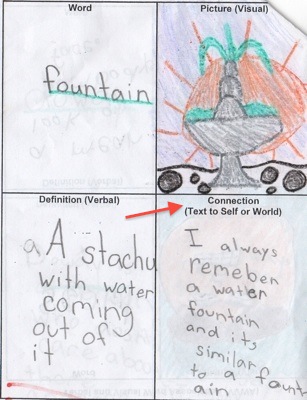
The other thing children will done on day two is work on  vocabulary with the words. They can draw pictures of the words or find pictures online to represent the words. They could act out words for a partner(s) to guess. They can basically do any game that focuses on word meaning.


Day 3: The Reading-Writing Connection
After students sort the words again, day 3 is when the word study goes even more authentic. This is a non-negotiable part of word study - kids have to find vocabulary in context.

Students may look for words that are in their sort or that fit the patterns in their sort in their Just Right books, in poems that the teacher shares with them, in leveled readers....whatever authentic reading materials they happen to be working with. They are essentially becoming word detectives - looking for new words and adding them to the lists they already have.

Be prepared though: They will find the "Oddballs." Oddballs are the words that should following a pattern (either for how it sounds or how it looks) but don't. Don't hide the oddballs. Use these words - talk about them, and then just have the kids file the words in an oddball category.

Day 4: Blind Sort and/or Games
On day 4, kids will do a Blind Written Sort with a partner. With this exercise, child A has the words in front of them and child B has a notebook and pencil. Child A reads the words to Child B, who writes them in their notebook with the correct pattern. The purpose here is that you'll want the kids to have the words in their vocabulary so much that they don't need the visual cue. When the words from their list are done being read and written, Child A checks the work from Child B and then they switch.


Now, you'll have to change things up - after awhile kids are going to get used to all these procedures. Day 4 can also be a day for word games - the Words Their Way text has lots of ideas for games, but you'll have to create them.

If you're not wanting to make tons of games for your Word Study but you'd like them - check out Teachers Pay Teachers. There are tons of docs you can buy on this website that other teachers have made - if you're in a pinch for time (or just don't want to make the games) there's so much on TpT that you can buy. You can also create an account there and sell your games! Extra money, whoohooo!

Also: day four could be the time of the week when the upper elementary kids begin to use the words in context - writing stories or sentences with their words.

Day 5: Assessment
On day 5, you will assess the group. They will create the columns with the headers as the word patterns. You will choose three to four words per pattern to dictate to them and they will write them in the correct column. If you assign grades: one point for spelling it correctly and one point for placing it in the correct column with the correct spelling pattern.

Also: add one word per pattern that wasn't in the sort but fits the pattern. You'll add these words to see if the kids get the generalizations that they worked on over the course of the week. Make sure to use that clearly fit the pattern - don't pick tricky words that could maybe be in two categories or fit in oddball. All you're trying to see by adding words is if kids get the generalization.


And that's it!


So there you have it! Now the vision is that most of this is small group work that fits in your Reading Workshop as part of the work students do each day. Of course, it won't happen magically over night that they know how to do all of this....so it's okay to start with a super easy sort and do it all together as a whole class for a few times first. Teach the procedures. Remember: Go slow to go fast.

Don't get stressed, either. Transformation in your reading instruction (or any area of your life) isn't a sprint....it's a marathon. As long as you are moving forward in your journey, you're on the right path. As much as we'd like to have everything perfect the first time and on a super quick timeline, it's just not possible.


So that's all for Saturday morning! Have a great weekend!


PS - One more (HUGE) thing that I didn't mention. Not sure what sorts to do? You can buy these books and it's all done for you - sequenced in a great order, building on one another...etc. Although only four are pictured here, there are five - one for each of the five stages: Emergent (kinder), Letter Name (first), Within Word (first-second), Syllables and Affixes (third-fourth), and Derivational Relations (fifth and up).


Emerson teachers: I have the original text of Words Their Way and I have the third, fourth, and fifth stages of word sorts. We will be ordering the others, just don't have them yet....


Saturday, August 10, 2013

Words Their Way: An Introduction


Are you familiar with Words Their Way? It's a word study program - ehhh, maybe not program - Let's just call it word study. The aim of word study begins by helping little kiddos with phonemic awareness (hearing sounds and then connecting them to letters), and as they grow, to help the bigger kiddos make generalizations about word and spelling patterns. Word study is also about vocabulary development - in the younger grades, it's talking about words on any given word sort, and in the upper grades, it's about Greek and Latin roots.

Word study is NOT:

  • memorizing a list of spelling words
  • taught in a whole group setting (perhaps in kinder it is...but after that, it differentiates.)
  • about homework completion
  • taught as a separate component outside of the reading and writing instruction.

Word study IS:
  • constructing meaning through examination of words
  • talking about words with peers and teacher
  • differentiation to meet student needs
  • encouraging an interest in words
  • comparing and contrasting words to form generalizations
  • integrated into your literacy workshops

So what does word study look like?


First grade student with short e, and long e patterns: ea, ee

Did you watch the video? This first grader is using the vocabulary words consonant and vowel to describe what he was doing. He also found the oddball - been - which should say (bean) but doesn't. It follows the pattern of the -ee- but the sound doesn't follow the pattern, making it an oddball. Amazing thinking he does aloud as his teacher tapes it.

So how do you do it?
Of course you will have do a little assessment and figure out which kids have like needs. You'll create up to three groups within your class. Then, you will give them sorts based on what their needs are.

The teacher will start with a fifteen minute introduction to the words with the small group. Then, children sort the words based on sound, pattern, and/or meaning. As children sort, they work with another student or two, discussing the words, and why they grouped them the way they did. The important thing here is that they:

  • Say the word they are sorting,
  • Lay the word into the appropriate group, and
  • Explain why they put the word where they did.

For example, the following words may be in a sort:


As the children are sorting, they are saying each word, talking about meaning (vocabulary), and putting the words in the correct place. Now, this one is obviously a suffix difference in how the words look, but there is more to this conversation. All of these words are adjectives, but the -able words are with base words that could stand alone. Also, the base words in these cases are verbs, and adding able changes it to an adjective. On the other hand, the words with the -ible suffix have a root word and these cannot stand alone.

Can you see how there's much more to the conversation than just the suffix? Students are talking about word meaning, grammar, and they are comparing and contrasting base and root words. They determine the pattern - the teacher is not telling them the pattern. Students are constructing their new learning in a social way. This kind of learning runs much deeper than being told about a rule or memorizing a random list of words.

Well, there will be more coming on Words Their Way - I will talk about how to integrate it into the workshop so it goes with their reading and writing, I have a five day plan for each sort, and will also be writing about assessment. In the mean time, you can pick up their book:


Do you already use Words Their Way? Any helpful tips or ideas? Please share!

Happy weekend!


Related Posts Plugin for WordPress, Blogger...